
Given DEPA was the jewel in the crown, Athens' chances of hitting €2.6bn asset sale target this year look extremely slim
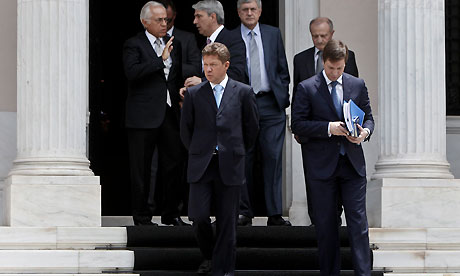
Gazprom chief Alexei
Miller (front L) leaves the Greek PM's office after a meeting last
month. The Russian energy giant has pulled out of talks to buy DEPA.
Photograph: John Kolesidis/Reuters
Greece's
already troubled privatisation programme lies in tatters after the
failure to sell the natural gas company DEPA to the Russian energy
company Gazprom. Given that DEPA was seen as the "jewel in the crown",
the chances of Greece hitting the target of €2.6bn (£2.2bn) of asset
sales in 2013 now look extremely slim. That's clearly a problem for the
government in Athens, which has been told in no uncertain terms by
representatives of the troika – the International Monetary Fund, the
European Central Bank and the European Union – that there must be no
further delays in privatising state-owned companies.
But it is also a problem for the troika, which will have to decide how to respond if – perhaps that should be when – Greece says it can't come up with this year's privatisation proceeds. Already on Monday, there was talk by the finance ministry of putting back the sale of the oil refining company, Hellenic Petroleum.
The troika would be within its rights to tell Greece to make up for the shortfall through additional cuts in public spending or by raising taxes. There are three reasons why it should not do so, however.
Reason number one is that ploughing on with privatisation at the current juncture would be a fire sale. Greece would get less, probably much less, than the assets are worth.
Reason number two is that Greece is actually over-achieving on deficit reduction this year, albeit at a terrible cost to the economy. Greece's primary budget deficit – which excludes debt interest payments – was just under €1bn in the first five months of 2013, well below the €4.2bn target. But that has only been achieved by slashing public spending and capital investment, contributing to an expected 4.6% decline in national output this year. Greece needs additional fiscal pain like a hole in the head.
Reason number three is that there will be plenty of people in Brussels and Washington who will be privately glad, on geo-political grounds, that Gazprom is not buying DEPA. Last week, the IMF admitted it had made mistakes in its handling of Greece. This is the time to cut a bit of slack, not to compound past errors.
But it is also a problem for the troika, which will have to decide how to respond if – perhaps that should be when – Greece says it can't come up with this year's privatisation proceeds. Already on Monday, there was talk by the finance ministry of putting back the sale of the oil refining company, Hellenic Petroleum.
The troika would be within its rights to tell Greece to make up for the shortfall through additional cuts in public spending or by raising taxes. There are three reasons why it should not do so, however.
Reason number one is that ploughing on with privatisation at the current juncture would be a fire sale. Greece would get less, probably much less, than the assets are worth.
Reason number two is that Greece is actually over-achieving on deficit reduction this year, albeit at a terrible cost to the economy. Greece's primary budget deficit – which excludes debt interest payments – was just under €1bn in the first five months of 2013, well below the €4.2bn target. But that has only been achieved by slashing public spending and capital investment, contributing to an expected 4.6% decline in national output this year. Greece needs additional fiscal pain like a hole in the head.
Reason number three is that there will be plenty of people in Brussels and Washington who will be privately glad, on geo-political grounds, that Gazprom is not buying DEPA. Last week, the IMF admitted it had made mistakes in its handling of Greece. This is the time to cut a bit of slack, not to compound past errors.





Δεν υπάρχουν σχόλια:
Δημοσίευση σχολίου
Σημείωση: Μόνο ένα μέλος αυτού του ιστολογίου μπορεί να αναρτήσει σχόλιο.