
Professor emeritus of the University of Ottawa, Fellow of the Royal Society of Canada, historian, poet and scholar of international stature, Dimitri Kitsikis is a Turkologist, Sinologist and specialist of international relations.
Family and personal life
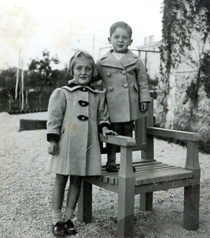
With his sister Elsa in Athens (1938)
Nikos Kitsikis' statue, on the waterfront of Herakleion harbour, erected in 2003
Nikos Kitsikis (1887-1978), born in Nauplion, professor and rector of the Polytechnical School in Athens, was a senator and Member of Parliament. His father, Dimitri Kitsikis senior (1850-1898), chief justice, had settled in Athens from Lesbos in 1865 where he married Kassandra, the sister of Dimitri Chatsopoulos, Member of Parliament from Karpenesi.
Dimitri Kitsikis,
senior(1850-1898)
Beata Merope Petychakis (1907-1986), a famed feminist and ELAS fighter against the German occupation of Greece, was born in Herakleion, Crete, from a wealthy Cretan family who married Greek Italian nobles from Trieste of mixed Roman Catholic and Orthodox origin. Her father, Emmanuel Petychakes had founded a beverage production plant in Cairo, Egypt, where he married Korinna, the daughter of count David d’Antonio (Antoniades), originating from Trieste, and her stepfather Aristeides Stergiades (1861-1949) was the High Commissioner of Greece in Smyrna from 1919-1922.

Beata Petychakis-Kitsikis, mother of Dimitri Kitsikis, with Chairman Mao Zedong in 1966
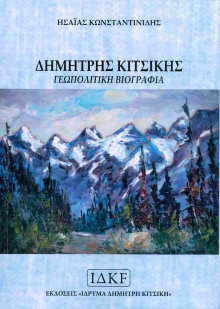
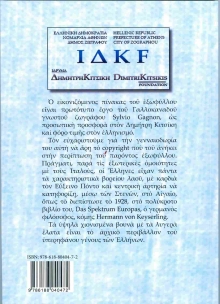
Today, the “Nikos Kitsikis Library and Archives”, resides in the home of Aristeides Stergiades in Herakleion. Nikos Kitsikis’ statue is placed at the entrance of Herakleion harbour which, as an engineer, he built in 1920.
Both of Dimitri Kitsikis’ sisters are prominent scholars as well. Beata Maria Kitsikis-Panagopoulos retired as Professor of History of Art from the State University of California San Jose, USA. Elsa Schmid-Kitsikis is psychonanalyst and retired Professor of Psychology of the University of Geneva, Switzerland. As one of the main world Piagetists, she had been a long-time collaborator of Jean Piaget (1896-1980) in Geneva.
Dimitri Kitsikis and his British wife Anne Hubbard, the daughter of a chief justice, were married in Scotland in 1955. The couple’s first child, a daughter, Tatiana Beata, was born in 1960, followed by a son, Nicolas, in 1962. Nicolas has been a Vaishnav since adhering to the Hindu religion in 1984. While he lives with his Hindu wife in the Vaishnav community of Gainesville, Florida, his sister, Tatiana, resides in Montreal, Canada. Dimitri Kitsikis and Anne Hubbard divorced in 1973.
Dimitri Kitsikis’ second wife, Ada Nikolarou, is the daughter of a farmer from the historical Byzantine town of Mystras, near Sparta. The couple got married in 1975 at the Greek Orthodox Church of Ottawa, Canada. Their son, Agis Ioannis, was born in 1979 and their daughter, Kranay Maria, in 1982.
Dimitri Kitsikis holds citizenships from Greece, France and Canada. He lives both in North America and Europe, splitting his time between Ottawa, Paris and Athens.
Early life and career
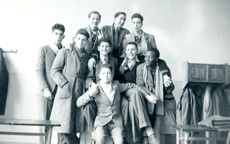
With classmates at the Lycée Lakanal in 1950 (2nd row, first from left)
He spends his first year in France as an intern at the École des Roches in Normandy before transferring for the next four years (1948-52) to the Lycée Lakanal in Sceaux, near Paris. His last high school year is at the Lycée Carnot, in Paris, from where he obtains the French Baccalauréat in 1953.
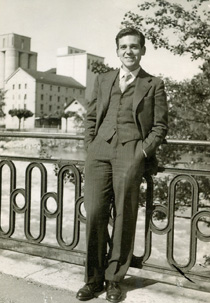
In Geneva (1953)
During the 1960s and early 1970s, Dimitri Kitsikis is a close friend and advisor of Greek Prime Minister Konstantinos Karamanlis senior (1907-1998, later President of Greece), who lives in exile in Paris at the time.
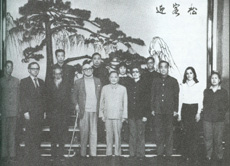
With the Greek delegation in Beijing in 1974 (1st row, 2nd from left)
Finally he accepts, in 1970, an Associate Professor position with the University of Ottawa, becoming full professor in 1983. During the first years in Canada, he also teaches – commuting between both cities – as an invited Professor at the Laval University in Quebec City.
Since moving to Canada, he has been living and working both in North America and Europe, splitting his time between Canada, Greece, Turkey and France. While holding his position and affiliation at the University of Ottawa, Dimitri Kitsikis regularly travels to both Greece and Turkey for short visits, or is invited for longer stays to teach and do research.
From 1972 to 1974 he is a senior resident researcher at the National Institute for Social Studies in Athens.
Aiming to resolve the Cypriot issue, he is – during the summer of 1975 – the unofficial ambassador of the Greek Government in Cyprus and Turkey.
He teaches, from 1976 to 1978, at the Deree College (the American University) in Athens, and during the 1980-1981 period, at the Boğaziçi University in Istanbul.

With Turgut Özal in 1990
Professor Kitsikis officially retires from the University of Ottawa in 1996. The same year he is elected Professor Emeritus. He keeps his office at the University and continues to teach at the undergraduate and graduate levels, being still a member of the Faculty of Graduate and Postdoctoral Studies.
In 1999 he is elected Fellow of the Royal Society of Canada.
Invited by the government of Yugoslavia, he is an international observer in Belgrade for the national elections in September 2000. Although representing Canada, he is part of the Greek delegation that leaves Athens, alongside with Karolos Papoulias, the current President of Greece.
In September 2008, the Greek government honors him by formally establishing the Dimitri Kitsikis Public Foundation in Athens by way of presidential decree.
Philosophy, Thought & Achievements
Since he was a child Dimitri Kitsikis had an idée fixe. He wanted not only to reconcile Greeks and Turks but also to unite them into a Greek-Turkish Confederation and to revive the Ottoman Empire. As early as the 1960s, he had been the recognized theorist, first in Greece and then in Turkey, of the idea of a Greek-Turkish Confederation, which he had promoted by influencing statesmen, politicians, journalists, artists and thinkers in both countries. His books in Turkish became best sellers in Turkey and were praised by Prime Minister of Turkey, Mesut Yilmaz. He kept close ties with Prime Ministers Karamanlis senior of Greece and Turgut Özal of Turkey. His books in Greek created one of the greatest controversies ever encountered in Greek historiography. They were even debated in the Greek Parliament. The well-established notion of Greeks enslaved by Turks, as well as a series of beliefs on the Ottoman Empire that had been traditionally taught in schools and universities throughout Greece, such as the story of the so-called “secret school,” were strongly questioned through his writings.
Born in an atheist family of intellectuals and public figures, Dimitri Kitsikis’ religious views developed throughout his life and, as an adult, he became a devout Orthodox Christian. Although a member of the official Church of Greece, he always sympathized with the Old-Calendarist movement, the adherents of which reject the Church’s use of the Gregorian (New) calendar and maintain a traditionalist attitude towards Christian life and worship. As Orthodoxy prevailed over the heresy of Iconoclasm in the 9th century and restored the use of the icon in Christian worship, he stands convinced that the Old Calendar will once again be adopted by those Orthodox Churches which rejected it in the earlier part of the 20th century.
He has insisted on the religious phenomenon as an essential component of international politics and strove by conferences and other means to facilitate the collaboration of religious communities, as in the millet system of the Ottoman Empire. He particularly believes in a dialogue between the four main religions of Judaism, Christianity, Islam and Hinduism. He organized Orthodox dialogues with Shia Muslims in Iran and Hindu vaishnavs in India. He worked closely with Turkey’s Sunnis and Alevis, with Israeli Jews and fundamentalist Catholics from Quebec, where he, along with his students, produced the quarterly journal “Aquila” (eagle) which, with a double-headed eagle on the front cover promoted the byzantine imperial idea amongst catholic circles. Finally, in order to form a basis for a future political union between Athens and Ankara, he came to sympathize with the Turkish religion of Bektashism-Alevism and saught to ally it with Orthodoxy.

Dimitri Kitsikis teaching in Ottawa, March 2013
Everywhere and at all times, the idea of a global Hellenism is prevalent in his work. His teaching is aimed at globalizing Greek thought in the present world.
While his father, rector of the Polytechnical School, was a Leftist Member of Parliament, Senator and elected Mayor of Athens, Dimitri Kitsikis is averse towards the parliamentrary system, which he regards as foreign to the Greek model of a government by the people or laocracy.
According to French Professors Pierre Renouvin and Jean-Baptiste Duroselle (Introduction à l’Histoire des Relations internationales, Paris, A. Colin, 1964), he has been the initiator in France of the branch of the History of International Relations that deals with propaganda and pressure as a government weapon of foreign policy. He also opened the way to the study of technocracy in international politics.
He has created a model for a new approach of the three political ideologies of Liberalism, Fascism and Communism, and has published on the history of China. He is the founder of the branch of study known as Photohistory. He is also a recognized poet with six books of poetry. In 1991 he was honored with the first Greek-Turkish prize for poetry Abdi İpekçi, a Turkish journalist who had been shot dead by terrorists. Three of his poetry books, became part of an anthology of 32 Canadian poets by H. Bouraoui and J. Flamand (eds), Ecriture franco-ontarienne d’ aujourd’ hui, Ottawa, Les Editions du Vermillon, 1989.
He is the founder of four concepts that revolutionized the history of the Greek-Turkish Area: a) The “Intermediate Region” of civilization, extending from the Adriatic Sea to the Indus River, between the Euro-American West and the Hindu-Chinese East. A published Ph.D. dissertation in German took as its subject this new concept (P. Davarinos, Geschichtsschreibung und Politik, Düsseldorf, Heinrich Heine University, 1995) and the Royal Society of Canada recognized its originality by electing him a fellow of the Society in 1999. b) Eastern Party versus Western Party as an antagonist couple; c) Hellenoturkism as an ideology and as a phenomenon of civilization for the last one thousand years; d) Bektashi-Alevi religious origin of the Ottoman Dynasty, the islamization of which developed hand-in-hand with its secularization and westernization.
In 2007, his 34th book under the title, “A Comparative History of Greece and China from Antiquity to the Present” was published in Greek. This unique work shows the relationship between the two civilizations throughout their history spanning three millennia and focuses on two concepts: the Greek-Chinese civilization in a planetary context and its political expression during the last 2500 years, that is, the ecumenical empire as the ideal organizational model.
Author of 36 books as well as hundreds of scholarly articles and co-author of many dozen books, on subjects such as international relations, the Middle East, geopolitics, political ideologies, religion and especially Turkish and Chinese history, his publications, mainly in Greek, French, English and Turkish have also appeared in Spanish, Portuguese, Serbian, Bulgarian and Russian. Interviews with him have also appeared in Chinese.
He contributes regularly with political articles to Greek magazines and since 1996, publishes in Greek a quarterly journal of Geopolitics named after his civilization model, “Intermediate Region”.
Chronological biography
1935 – Dimitri Kitsikis is born in Athens
1947 – Departure for France
1947-1948 – École des Roches in Normandy
1948-1952 – Lycée Lakanal in Sceaux
1952-1953 – Lycée Carnot in Paris
1953 – Obtains French Baccalauréat in Paris
1953-1954 – 1st year both in Medicine and Arts at the Sorbonne in Paris
1954-1955 – 2nd year in Medicine at the University of Geneva
1955 – Wedding with Anne Hubbard in Scotland
1955-1958 – Graduates with an Arts degree from the Sorbonne in Paris
1958-1962 – Doctoral studies at the Sorbonne in Paris
1960 – Birth of first daughter, Tatiana Beata, in Paris
1960-1962 – Research attaché at the Institut Universitaire de Hautes Etudes internationnales in Geneva
1962 – Birth of first son, Nicolas, in Paris / Obtains Doctoral degree from the Sorbonne in Paris
1962-1965 – Research attaché at the Centre de Relations internationales (CERI) of the Fondation Nationale de Science politique in Paris
1965-1970 – Research attaché at the Centre National de la recherche scientifique in Paris
1962-1970 – Teaching assistant at the Sorbonne in Paris
1968 – Active participation in the student revolt and dismissal from the Centre National de la recherche scientifique and the Sorbonne, in Paris
1970 – Associate professor at the University of Ottawa
1972 – Tenured professor at the University of Ottawa
1972-1973 – Visiting Professor at the Laval University in Quebec City
1972-1974 – Resident senior researcher at the National Institute for Social Studies in Athens
1973 – Divorce with Anne Hubbard
1975 – Wedding with Ada Nikolarou in Ottawa / Unofficial ambassador of Greece in Cyprus and Turkey
1976-1978 – Visiting Professor at Deree College, the American University in Athens
1979 – Birth of second son, Agis Ioannis, in Ottawa
1980-1981 – Visiting Professor at Boğaziçi University in Istanbul
1981 – Citation for Valuable Achievements and Contributions to the Study of Ataturk’s Principles, Boğaziçi University, Istanbul
1982 – Birth of second daughter, Kranay Maria, in Ottawa
1983 – Promotion to full Professor
1986 - Participation in Bombay, India, at the First World Congress on the Synthesis of Science and Religion
1988 – Representative of the Mayor of Greek Sparta to Isparta, Turkey
1990-1991 – Vice President, Association des Auteurs de l’Ontario
1990-1994 – Organizer of the First, Second and Third International Symposiums on Orthodoxy and Islam, Athens and Tehran
1991 – Nominated University of Ottawa for Excellence in Research
1991-1992 – Visiting Professor at Bilkent University in Ankara
1991 – Abdi İpekçi Greek-Turkish First Prize for Poetry
Since 1995 – Elected representative of Greece to the International Committee of the Association des Amis de Maurice Baumont (1892-1981)
1996 – Officially retires from the University of Ottawa / Elected Professor Emeritus
1999 – Elected member of the Royal Society of Canada
2000 – International observer at the national Yugoslav elections in Belgrade
2008 – The Dimitri Kitsikis Public Foundation is officially established in Athens
2010 - Award "Homo Hellenicus", for his achievements in spreading Greek Civilization worldwide. Hellenic Evergetes Society, Athens, Greece
2010 - Visiting professor at the Sun Yat-sen (Zhongshan) University, Guangzhou, China
2011 - Visiting professor at Gediz University, Izmir, Turkey
2011 - Gediz University Award for exceptional scientific achievements. Izmir (December 14)
2011 - Invited by Alexander Dugin, at the Moscow Lomonosov University in order to discuss a possible synthesis between Dugin's Eurasianism and Kitsikis's Intermediate Region, in December.
2012 - Key speaker, Ιnternational Conference on the Arab Spring at Bilkent University in Ankara, Turkey, in March.
2012 - Key Speaker at the Indian Museum of Kolkata Seminar, May 23rd-25th, on "The Importance of Ancient Indian Culture for Making a Better World", Kolkata, India
2012- Key Speaker, September 21-23, Heraklion, Crete, in the Symposium: "Let's meet again: We are the Greeks".
2012 - Award to the Kitsikis Foundation for its contribution to the spreading of Greek values worldwide. Hellenic Evergetes Society, Athens, Greece.
2012 - Key speaker, on «The Great Immigration of the Greeks Throughout the World and their Contribution to the Motherland». Symposium on the Greek Evergetes, in Piraeus and Athens, Greece, 30th September- 1rst Oct.
2013 - Invited to take part in Izmir, Turkey, in the 90th Anniversary Rememberence Day of the January 30, 1923 Lausanne Convention on the Compulsory Exchange of Populations between Greece and Turkey. Delivered a conference as key speaker in Izmir entitled: "Population Exchange of 1923 between Greece and Turkey. The Aftermath" - January 30.
2013 - Member of the Board of Referees of the Journal of Modern Turkish History Studies, Dokuz Eylül University, in Izmir.
2013 - Represented the Research Center of the Dimitri Kitsikis Public Foundation at the 11th Rhodes Forum, October 2-6, as a key speaker. This 11th annual Rhodes Forum of the Russian Dialogue of Civilizations, under the direction of Vladimir Yakunin honored the Foundation through its founder Dimitri Kitsikis.
2013- Invited by the University of Paris as a member of the jury to the doctoral thesis
of Marc Lambinet, October 7-13.
2013- Invited as a key speaker at Herakleion, Crete, October 23-27, by the Vikelaia Library, for the 100-year anniversary of the Union of Crete to Greece, as well as by Crete TV (October 25) and Herakleion Radio 984 (September 30 and October 21).
2014- Invited at an international meeting in St Petersburg (March 29-30) at the highest level, due to the initiative of President Putin, with the aim of condemning the antisemitic regime established by coup d'etat in Kiev with the support of Washington.
2014- From August 18 to 23,the vice-mayor of the city of Heraklion in Crete, Petros Iniotakis, invited Dimitri Kitsikis and took from him long interviews in order to publish a book on his life. During his stay in the birthplace of his mother Beata, Dimitri Kitsikis also gave several interviews to the local media.
2014- Invited as a key speaker at the 12th Rhodes Forum, September 25-29, under the direction of Vladimir Yakunin. Also gave interviews to the Media.





Δεν υπάρχουν σχόλια:
Δημοσίευση σχολίου
Σημείωση: Μόνο ένα μέλος αυτού του ιστολογίου μπορεί να αναρτήσει σχόλιο.